What Is Ruby on Rails & Why Use It for Web Apps?

Victor Motogna
Head of Engineering
Reading time: 3 min
Updated: Jul 2, 2026
Key takeaways
- Ruby on Rails is an open-source web application framework written in Ruby, built on convention over configuration and DRY principles.
- Rails is developer-friendly, with English-like syntax that makes projects easy to learn, read, and hand over.
- The framework speeds up development and prototyping, so teams focus on business logic instead of setup.
- Rails is mature and business-oriented, letting you scale, refactor, and add features without technical roadblocks.
- The current stable version is Rails 8.1, which runs on modern Ruby (3.2 or newer) and simplifies self-hosted deployment.
At Wolfpack Digital, our tech stack for web applications pairs Ruby on Rails with Vue.js. We deploy on Heroku, Kubernetes, DigitalOcean, Microsoft Azure, Docker, and Amazon Web Services.
Many technologies can build a web app. But Ruby on Rails web development stays a favourite for a reason. Here is our take.
What is Ruby on Rails?
Ruby on Rails (RoR) is a web application framework written in Ruby. It is open source under the MIT License. Rails gives developers a clean structure to build web apps and sites. It also handles many common, repetitive tasks for you.
Rails follows two core ideas. The first is convention over configuration. The second is "don't repeat yourself" (DRY). Together, they keep code lean and easy to read.
Why choose Ruby on Rails for web development?
We asked our web developers why they love Ruby on Rails. We also checked the official Rails site and community forums. Here are four reasons to build your web app with Rails.
1. Ruby on Rails is developer-friendly
The syntax reads almost like plain English. It is easy to learn, read, and follow. Rails conventions also help developers move between projects fast.
This makes handover simple. You can pass a project from the agency to the client with ease. You can also add people to a team without breaking the code.
2. It speeds up development and prototyping
Rails lets you focus on your business logic. You spend less time on setup and boilerplate. The result is a faster build, even for complex products.
3. Rails is a mature framework
Rails is proven over time. It has a large community and clear conventions. It often solves problems that newer frameworks still struggle with.
Its guidelines also serve the business side. DRY code and strong conventions save both time and money.
4. It takes a business-oriented approach
Rails helps the team focus on the real problem the app must solve. The framework is a tool, not the goal.
Over time, good Rails developers grow tool-agnostic. They focus on the problem, not the stack. So you can scale, refactor, or add features without hitting technical walls.
Popular apps built with Ruby on Rails
Many well-known products run on Rails, including:
Ruby on Rails keeps improving
Rails is far from standing still. The framework ships steady releases, and the current stable version is Rails 8.1. It runs on modern Ruby and requires Ruby 3.2 or newer.
Rails 8 leans into simple, self-hosted deployment. Tools like Kamal, Solid Queue, Solid Cache, and a built-in authentication generator ship in the box. The goal is to let small teams run apps at scale with fewer moving parts.
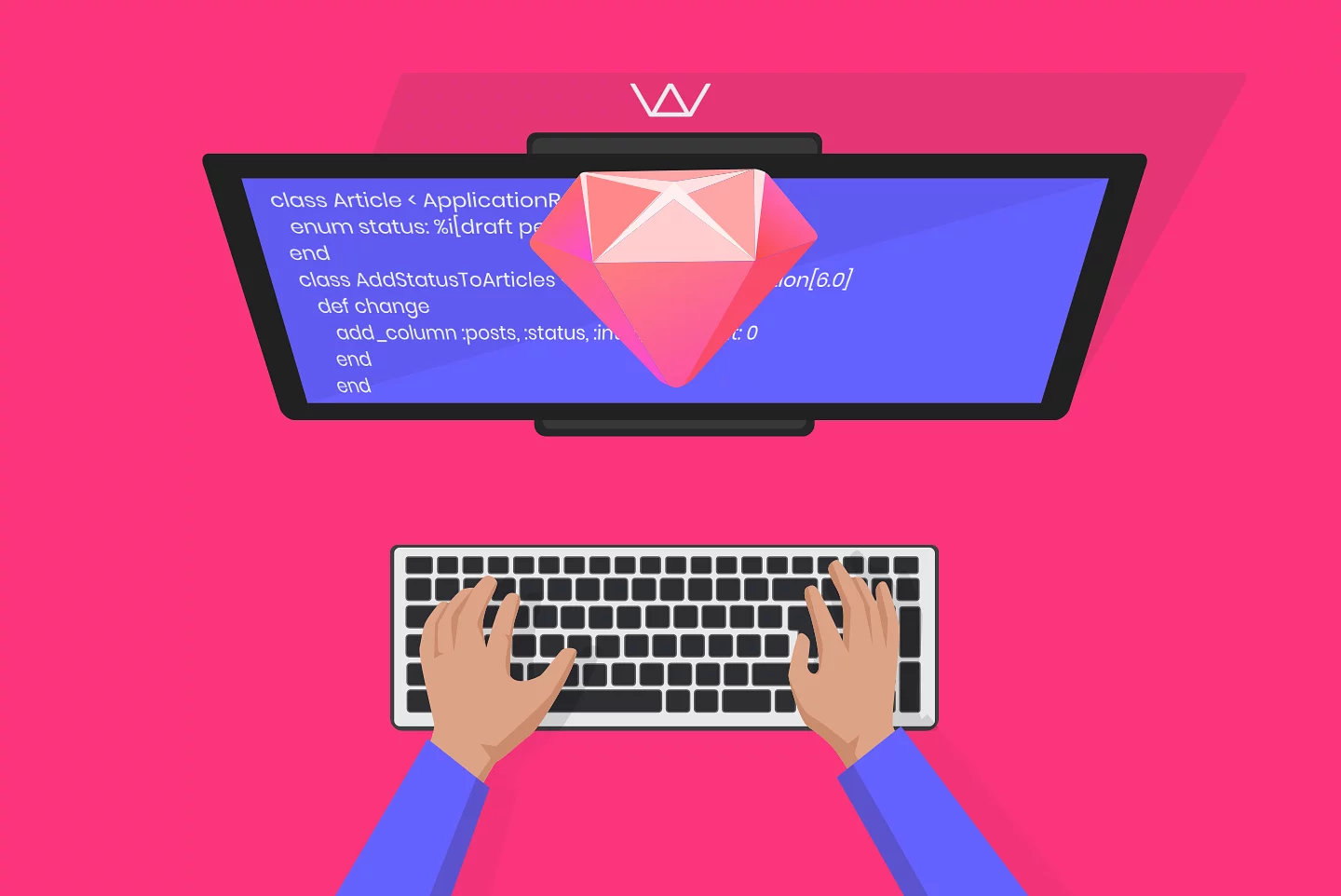
Recent versions also refined day-to-day work. For example, you can set a default value for an Active Record enum right in the model:
class Article < ApplicationRecord
enum :status, [:draft, :pending, :published], default: :draft
end
Before, you set that default in a database migration. The model-level option brings clear wins:
- You can change the default without a new migration.
- Rails warns you if the default is not a valid enum value.
- The default is easy to spot in the model, not buried in the schema.
This sounds technical. But the business impact is real. Cleaner code is faster to read, test, and scale. So you can grow features with less risk.
Build your web app with Wolfpack Digital
Want to build a strong web app? We have your back. Drop us a line in the chat or the contact form. We guide you from strategy and wireframing through prototyping, development, and QA to launch.
About Wolfpack Digital
Wolfpack Digital is a web and mobile app development company. We have delivered hundreds of projects for partners worldwide. Our mission is to bring performance and beauty to the world through technology.
We build products start to finish. Our expertise spans fintech, healthcare IT, e-commerce, and custom web development. Curious how we work? See our web and mobile development process.
Do you have a project in mind? Get in touch, and let's talk!