The Top 5 Internet of Things Use Cases

Andi Nicolescu
CTO
Reading time: 10 min
Published: May 12, 2022
Key takeaways
- The IoT market was worth about $864 billion in 2025 and is forecast to pass $1 trillion in 2026, reaching $5.55 trillion by 2034.
- In healthcare (IoMT), connected devices enable remote monitoring, telemedicine, hospital navigation, and automated test-result sharing.
- In energy, IoT improves grid management and microgrids, and lets homes and offices cut waste and costs.
- Industrial IoT (IIoT) uses sensor data for predictive maintenance, worker safety, quality control, and supply-chain visibility.
- Smart logistics and smart cities round out the top use cases, from fleet tracking and public transport to 15-minute-city planning.
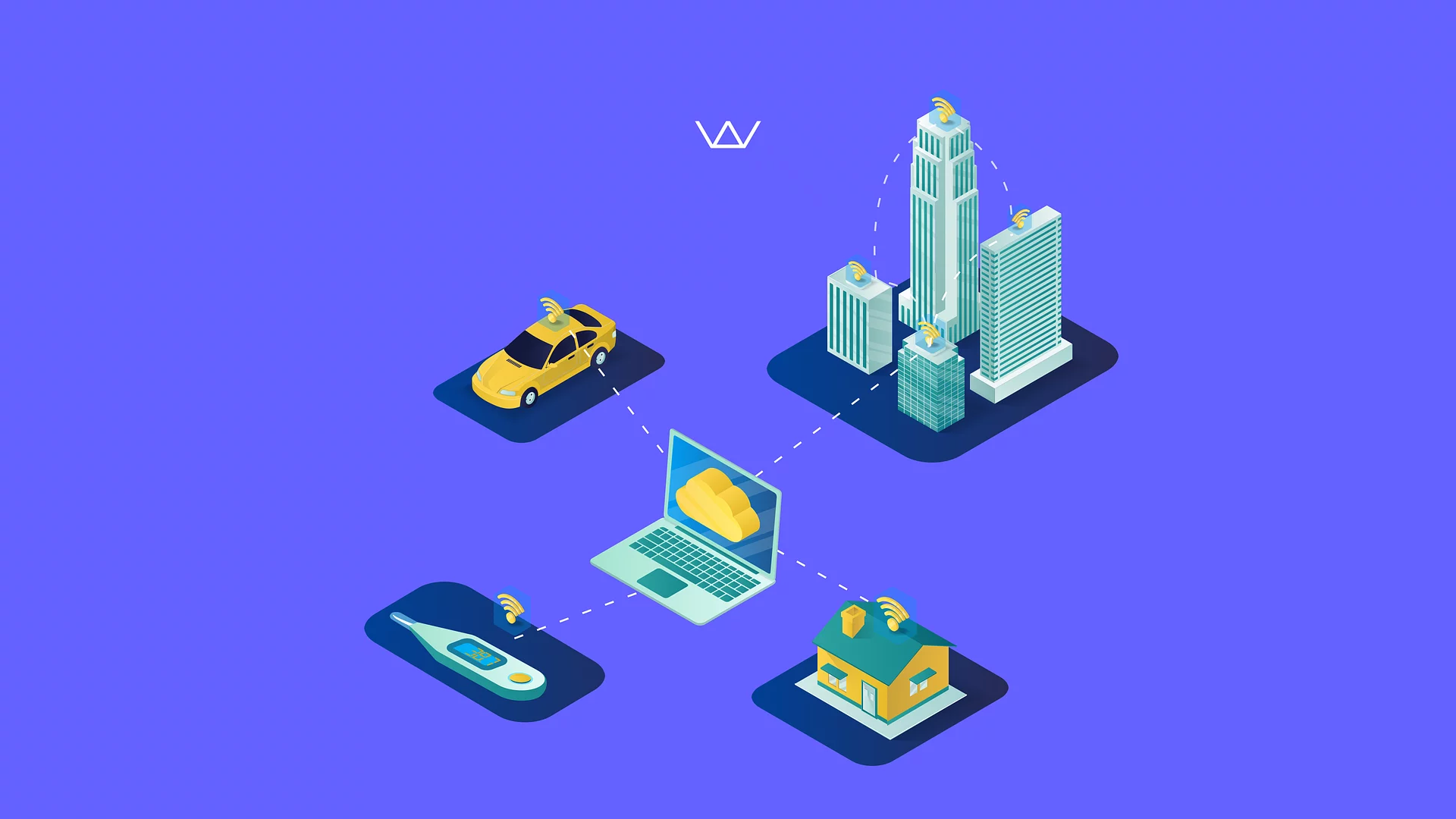
The Internet of Things (IoT) is a network of smart devices that work together. As a whole, they become more than the sum of their parts. And they keep changing our daily lives in big and small ways.
It is easy to think of IoT as just fitness trackers or smart appliances. But it is far bigger than that. Many niches have grown on their own. Across dozens of industries, people use connected devices, run through apps, to make work and life easier.
To show how varied IoT can be, here are three products we built at Wolfpack Digital. Storyball pairs a mobile app with a physical toy ball. It entertains and teaches children, and keeps them off screens. GoalPlay is a smart goalkeeper glove, one of Oliver Kahn’s projects. It sends players tailored advice and drills based on their performance. PowerMedic is a tablet app linked to a medical laser. It supports therapies from injury recovery to dentistry. In short, the IoT is broad.
Now look at the industry as a whole. In 2025, the IoT market was worth about $864 billion. It is forecast to reach roughly $1.05 trillion in 2026. By 2034, it could hit $5.55 trillion, a compound annual growth rate of 23.1%.
Analysts expect that momentum to continue. More industries are connecting their devices and acting on the data.
So how can your company benefit from apps that manage and talk to physical equipment? A good first step is to look at the top use cases in your industry. See how automation and a mix of software and hardware can boost efficiency. That often sparks the next idea. Some use cases below are well established. Others are still emerging. Let’s begin.
1. Internet of Medical Things (IoMT) 🏥
Smart devices are a big win in Medtech. They can monitor biometrics around the clock. They also build a stronger link between patients and staff.
Telemedicine is a great example. Devices watch a person’s health and can flag emergencies fast. They even help start treatment. And they let patients and staff stay in touch across any distance.
IoT tools that track blood pressure or blood sugar are now common. But there is more. Take the other metrics from biosensors and fitness trackers. Add an app that turns the data into clear insights. The possibilities open right up. 🙌
Hospitals gain too. Picture test results sent automatically across machines and gathered in one place for doctors and patients.
Say a patient arrives short of breath. Doctors might order blood tests, a lung X-ray, and urine tests. Connect that equipment, in the cloud for example, and the data arrives as it is ready. Software then paints a full picture of the patient. Everyone gets the data securely, well formatted, and on their computer or phone. This needs a web or mobile app with strong security and clear UX.
Here are two more scenarios where IoT helps healthcare.
Beacons (small radio transmitters) across a large hospital help people find their way by phone. Staff, patients, and visitors reach the right place fast. 🗺️ For staff, a native app often works best, since it can pack in more features. For patients, a progressive web app is easier, as it needs no install.
Connecting the lights and heating to a network keeps rooms comfortable and cuts costs. Staff can set the temperature remotely, or have it change once a room is empty. It works much like a smart home app such as Google Home.
Innovators keep finding new uses too, like ingestible sensors, surgery robots, and brain-monitoring devices.
If this caught your eye, check out our healthcare app tips.
2. IoT Enhanced Energy Solutions ⚡
Always-on devices that share data can cut waste in many industries. The energy sector stands out.
For electricity providers, IoT helps with:
- Managing the grid with sensors and software that finds the best output.
- Watching remote sites for maintenance, so gear does not fail between checks.
- Sharing renewable energy by need and supply. This system is a microgrid.
- Spotting inefficiencies and fixing them.
This is an industry that wants the best results at the lowest cost. So the IoT is fast becoming a go-to solution. Smart homes, offices, and other smart spaces are on the rise.
Consumers gain as well. Smart meters reveal wasteful habits and help you save. Sensors on lights and heating cut waste when no one is in the office. You can also control your energy use from your phone. An app can even suggest ways to spend less. 💡
For context, the U.S. Energy Information Administration (EIA) notes that cooling, heating, and lighting take a large share of home electricity. Connected devices can improve all of these figures without hurting comfort.
3. Industrial Internet of Things (IIoT) 🦾
Manufacturing is one of the biggest investors in smart devices. Per Statista, the industrial IoT market will keep growing fast, heading toward the trillions over the coming decade. 💰
So why does it justify the investment? The short answer is data. Sensors gather it in huge volumes.
Modern factories run complex processes. So inefficiencies are hard to spot. Connect the key machines, gather data, and process it. Then you can:
- Use predictive maintenance to cut breakdowns.
- Reduce accidents by spotting danger early and tracking worker status in real time.
- Track usage and wear on industrial gear.
- Keep quality high through condition monitoring.
- Track inventory and equipment on a shared network.
These uses apply to one site. But most products use parts from many factories worldwide. With so many moving parts, delays can cause a snowball effect. IoT visibility across the supply chain helps teams catch problems early.
4. Smart Logistics and Transportation 🚚
In logistics, vehicles report their location by GPS. Factories track gear with low-power wide-area networks. A central hub then coordinates every node through one app. That full view leads to better decisions and lower costs. Couriers can pack more cargo, plan smarter routes, and deliver faster.
With enough sensors, a stable network, and a smart app, regular cars edge closer to self-driving. 🏎️ We are cautiously optimistic. It seems autonomous truck fleets may arrive first. Even before then, cars can share data to warn drivers of hazards.
IoT also shines in public transport. Connected vehicles give riders live updates, easy contact with staff, and accurate tracking. Transreport is a great example. It makes transport more accessible for passengers across the United Kingdom.
5. Smart Cities 🏙️
Smart cities are close to our hearts. Cluj-Napoca, home of our Wolfden, has been named among Europe’s smartest cities.
To improve life for residents, cities are trying many ideas, such as:
- Digital public services.
- Free wifi and electric chargers.
- Connected public transport.
- Smart parking.
- IoT-enabled energy distribution.
- Air and water quality monitoring.
- Smarter waste management.
Other famous smart cities include Singapore, New York, San Francisco, London, Barcelona, and Paris.
Technology matters here, but so do the ideas behind each choice. One example is the 15-minute city.
The idea is simple. Every resident has what they need within a 15-minute walk or cycle. That takes lots of data for planning. It also takes strong digital services, so anything not nearby can be offered online.
The big lesson is this: small features add up to a much better experience. Together they cut pollution, save energy, and serve residents better. ♻️
You can see it in the global smart city market. The top focus is transport, the top utility is energy, and the top citizen service is smart healthcare, all topics we covered above.
Conclusion 💡
The Internet changed how we live, and it still does. These five use cases will keep growing. And who knows what else IoT will transform next.
There will be challenges. One is the balance between useful data and being intrusive. Another is security, so the IoT does not become a hacker’s playground. Solutions also need to work together. That is why standards and set protocols matter.
So how can you use IoT in your own product? The five industries above are fertile ground for startups. The key is simple. Your product must solve a real problem in a new or better way.
Play to your strengths. If you know a sector or technology well, use it to stand out. Then ask: how can automation and connected devices help your business?
Found this useful? Tell us what else would help, and see how our work applies to real IoT projects.
Want help with an Internet of Things app? Shoot us a message. Until next time! 👐