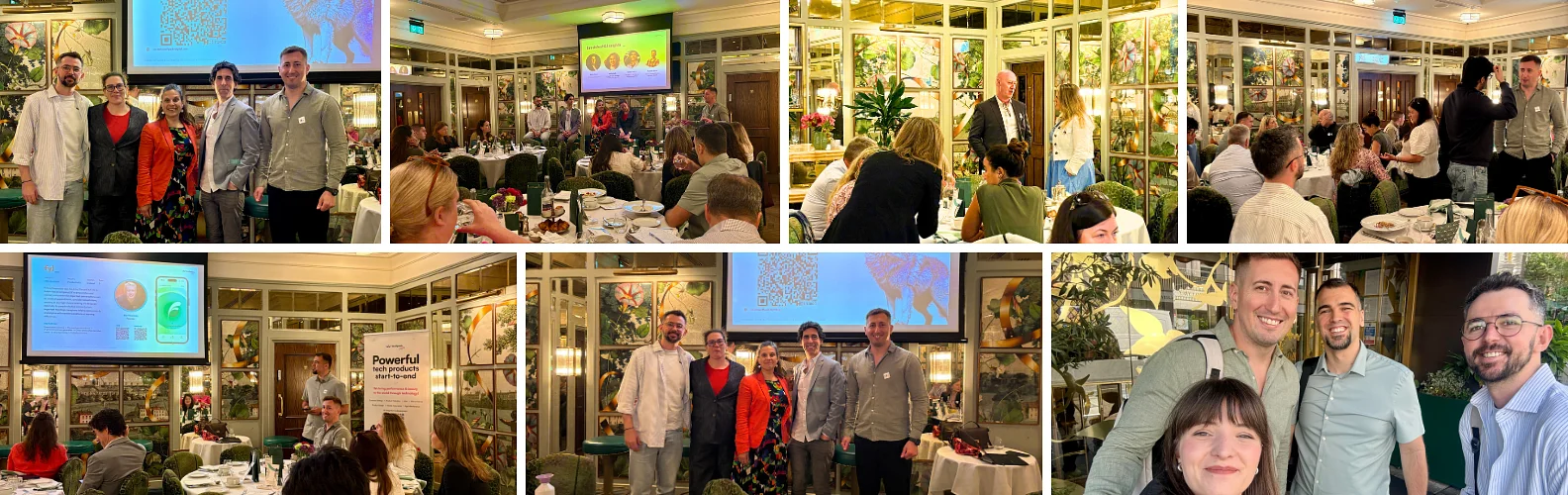
On Monday, 25 May 2026, founders and decision-makers gathered at The Ivy Dublin for breakfast to discuss one big question: “What should I build, and can I afford it?”
This was our third “Breakfast & Insights” session in Dublin. On the panel: Sinead Byrne (CEO and Founder, Prospera), Maria Gallo (Strategic Projects Manager, Trinity Business School), Brian Lavery (non-executive director and fractional executive), and Cristian Virciu (Head of Product Design, Wolfpack Digital), with Valentin Trif, Head of Business Development at Wolfpack Digital, moderating.
The conversation ranged from budgets and quotes to the bigger question beneath it all: “how do you choose the right people to build with?”. When you pick a vendor, you do not want someone who just agrees with you. You want someone who will speak up when you are about to make a mistake.
These are just a few takeaways. The morning covered much more, including how to compare very different quotes for the same project, what to cut if your budget is fixed but your roadmap isn’t, and how to decide what to build after your first product ships. Here are some of the main points.
Build what you can, then bring in a partner
Many founders in the room were non-technical, so the question of building it yourself or hiring an agency was on the table. The consensus leaned toward a sequence rather than a binary. See how far you can get on your own, then bring in a partner for the parts that need real engineering depth.
AI tools now make it possible to get started on your own. You can use them to test your idea, check demand, and show a basic version to users before spending a lot of money. If the feedback isn’t great, you’ve avoided a costly build.
Things change once you know people want your product. At that stage, everyone agreed not to cut corners on data security. This is when a professional partner becomes essential, and a quick AI prototype is no longer enough.
Where an agency actually earns its fee
A few reasons came up for working with a partner rather than going it alone:
Data security. After you’ve confirmed demand and have real users, security becomes a must. An experienced team will build it in from the start instead of bolting it on later.
Accountability. Make sure there is someone on the hook for the outcome. A clear owner who takes ownership of the work is worth more than any feature list.
Relationships and trust. AI can write code, but it can’t build a relationship. You need to trust the people you work with, because the hard moments in a project are solved by people, not tools.
You don't want a yes-man
Once you have chosen that partner, the warning from the room was simple: do not pick a yes-man. Someone who agrees with everything feels easy to work with, right up until the project goes sideways. A good development partner pushes back, questions the scope, flags the risky shortcut, and tells you: “I wouldn’t build it that way.” That is them protecting your budget.
Agreement is comfortable, but honest disagreement, early, is what keeps a product on track.
Ask who is actually on your project
A common issue came up several times. A big agency name might look impressive, but the senior people who win your business usually aren’t the ones writing your code. As one panelist said, the name might sound great, but the team you get could be very different.
The practical advice was to ask directly: “who is designated to my project?”. Get their names, find out how experienced they are, and understand who you will be talking to week to week. That tells you far more than the logo on the proposal.
Your network matters here, too. Trusted introductions and a strong professional network shorten the search for a credible partner, and that network is hard for an early-stage startup to build from scratch.
AI changes the speed, not the last 20%
Everyone was honest about what AI can and can’t do. It speeds up design and early development, but it doesn’t finish the job.
Building an app isn’t the same as building a finished product. AI can get you most of the way, but the last 20%, the polish, handling edge cases, and making it truly usable, comes from you and your trusted team. That final stretch is what keeps people coming back.
Get the right advice from the start
The line that summed up the morning was to make sure you get correct advice from the beginning. Good advice up front saves you from expensive corrections later, and the right partner gives it to you before you have spent the money.
A look at Fyl, one of our latest launches
The morning wasn't all a panel discussion. Gabriel Olariu, Business Development Manager at Wolfpack Digital, also showcased Fyl, a recent app from Wolfpack Digital, which perfectly illustrated the panel’s main points.
Fyl is a free mobile app for iOS and Android, developed for Dublin-based DisrupSTAR Ltd. It works as a preparation and memory companion for important conversations, from medical appointments and specialist consultations to performance reviews and any other high-stakes meeting. It's designed for people who feel anxious before big conversations, caregivers supporting aging parents, and anyone managing a memory condition or learning difference. The app records conversations, captures pre-meeting voice memos, generates AI-powered summaries, builds a narrative across related conversations, and lets you share notes in one tap, with full ownership of your data.
What's next
Breakfast & Insights runs as a recurring series in Dublin, and the conversation gets better with the people in the room. If you want an invitation to the next one, get in touch with the Wolfpack Digital team. The pack is already planning it.
If you are weighing up what to build and who to build it with, that's the conversation we have every day. Reach out and let's talk it through!